Volume: 3 Issue: 2
Hoarseness Is Not Always Benign; In Some Cases, It Heralds Small-Cell Carcinoma
Year: 2026, Page: 68-70, Doi: https://doi.org/10.71325/ajjms.v3i2.26.20
Received: May 9, 2026 Accepted: May 25, 2026 Published: Aug. 12, 2026
Abstract
Introduction: Hoarseness is a common complaint in otorhinolaryngology, often due to benign causes. However, it may occasionally signify serious underlying disease, including thoracic malignancies such as small cell carcinoma. Recognizing such atypical presentations is vital, especially in elderly smokers. Case Report: A 76-year-old male presented with a 3-week history of hoarseness and productive cough. Laryngoscopic examination revealed left vocal cord palsy. Imaging showed a right lower lobe mass with mediastinal lymphadenopathy. Histopathology and immunohistochemistry of a right cervical lymph node confirmed metastatic small cell carcinoma. Despite initiation of chemotherapy, the patient succumbed to pulmonary hemorrhage seven months after diagnosis. Conclusion: This case highlights the need for thorough evaluation of unexplained hoarseness in elderly patients, particularly smokers. Small cell carcinoma, though aggressive and rapidly metastatic, may initially manifest as vocal cord palsy. Early recognition and multidisciplinary management are essential for better outcomes.
Keywords: Recurrent laryngeal nerve palsy, Small cell carcinoma, Neuroendocrine tumor, Immunohistochemistry, Laryngoscopy
INTRODUCTION
Unilateral vocal cord palsy is typically a manifestation of an underlying condition rather than a primary disease. Common causes include bronchogenic carcinoma, trauma, iatrogenic injury, mediastinal lymphadenopathy, aortic aneurysm and left atrial enlargement[1]. This can compress the recurrent laryngeal nerve (RLN) at various levels, particularly in the aorto-pulmonary window (APW). Mediastinal lymphadenopathy at the APW is a rare cause, accounting for approximately 0.45% of unilateral RLN palsy. Small cell carcinomas are often grouped with carcinoid tumours due to their likely origin from common neuroendocrine precursor cells[3]. These tumors are characterized by rapid growth and early, widespread metastasis, most frequently involving the mediastinal lymph nodes. This report presents a rare case of left recurrent laryngeal nerve palsy due to mediastinal lymph node metastasis from a right lung malignancy[2, 4, 5].
CASE HISTORY
A 76 years old farmer from admitted in AJIMS on 25 Jun 2024 with complaints of change in voice and cough with expectoration since 3 weeks and was apparently normal before 3 weeks, voice change was sudden in onset, non progressive, continuous type and no history of diurnal variation of voice or voice fatigue. He gives history of loss of appetite since 3 months. However, there is no h/o fever, sore throat, or dysphagia. He is not Diabetic or Hypertensive. His bowel and bladder habits are normal. He had history of smoking beedi (40 pack-years) and no history of alcohol consumption. No h/o similar complaints or malignancies reported among first-degree or extended family members.
CLINICAL FINDINGS
Video Diagnostic Laryngoscopy Findings
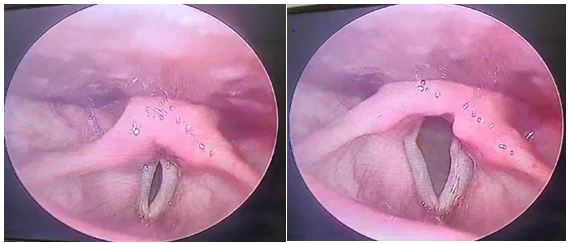
Fig. 1
-
The left vocal cord showed absent mobility, bowing, and was noted to be in a paramedian position.
-
The left arytenoid appeared anteromedially placed.
-
There was compensatory overriding of the right arytenoid.
-
A flickering movement of the left vocal cord was observed during phonation.
-
No local lesion or cause was identified.
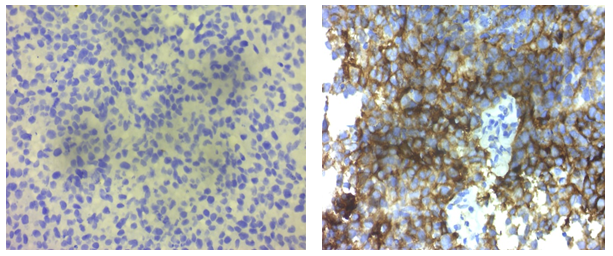
Fig. 2
USG guided Right cervical lymph node biopsy was done and sent for histopathological examination which showed small round blue cells with scanty cytoplasm (appearing as high nuclear-to-cytoplasmic ratio), hyperchromatic nuclei and absent nucleoli suggestive of metastatic small cell carcinoma ([Fig. 2]). Immunohistochemical marker study was done i.e. CD65 and Pan CK that showed diffuse strong positive in tumor cells which confirms the diagnosis of metastatic small cell carcinoma.
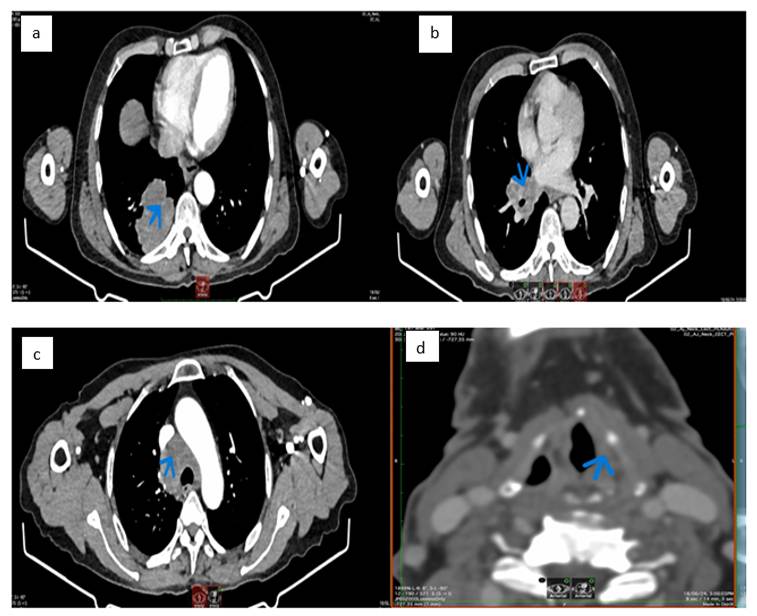
Fig. 3
The axial contrast-enhanced CT image of the chest shows ill defined large soft tissue density lesion measuring 6.5(CC) x 6.1(AP) x 4.6(TR)cm noted in posterior basal segment of right lower lobe ([Fig. 3]a). The CT scan shows an enlarged mediastinal lymph node, with the largest node measuring approximately 5 × 4 cm located in the right paratracheal region ([Fig. 3]b). There is also a prominent subcarinal or right hilar lymph node visible inferior and posterior to the carina ([Fig. 3]c). Axial CT image of larynx showed reduced bulk of left true vocal cord which indicates paramedian position of left vocal cord ([Fig. 3]d).
The patient received six cycles of chemotherapy (Inj Carboplatin), but he succumbed in January 2025 due to pulmonary haemorrhage as a complication due to small cell carcinoma of lung.
DISCUSSION
Hoarseness is a common symptom encountered in otorhinolaryngology, often attributed to benign causes such as laryngitis or vocal abuse. However, as demonstrated in this case, hoarseness may serve as the initial and sometimes the only presenting symptom of serious underlying pathology, including bronchogenic carcinoma.
Unilateral vocal cord palsy is frequently linked to pathology along the course of the recurrent laryngeal nerve (RLN), particularly on the left side, owing to its longer intrathoracic course. The nerve is vulnerable to compression by lesions in the mediastinum, especially at anatomical narrowing such as the aortopulmonary window. In our case, metastatic mediastinal lymphadenopathy from small cell carcinoma of the right lung was the causative factor.
Small cell carcinoma is an aggressive neuroendocrine tumor characterized by rapid growth, early dissemination, and a predilection for mediastinal lymph node involvement. The diagnosis in this case was established through imaging and histopathological examination, with immunohistochemical confirmation. Unfortunately, despite initiation of chemotherapy, patient had pulmonary haemorrhage, a known complication of advanced lung malignancy, which led to the patient's demise.
This case highlights the critical importance of considering malignancy in elderly patients presenting with hoarseness, particularly those with risk factors such as a significant smoking history. Early detection and consistent oncological management are vital to improving outcomes in such patients.
CONCLUSION
Hoarseness, especially when persistent and unexplained, warrants thorough evaluation to exclude serious underlying causes such as small cell carcinoma. This case underscores the need for clinicians to maintain a high index of suspicion and to ensure timely imaging and biopsy in patients at risk. Furthermore, adherence to oncological treatment protocols and regular follow-up play a pivotal role in optimizing prognosis in small cell carcinoma with mediastinal lymph node metastasis.
Key messages
-
Hoarseness may indicate serious pathology – Persistent or unexplained hoarseness, especially in elderly patients, should prompt evaluation for malignancy, not just benign laryngeal causes.
-
Unilateral vocal cord palsy warrants thorough investigation – Compression of the recurrent laryngeal nerve by mediastinal lesions, such as lymphadenopathy, can cause vocal cord paralysis.
-
Small cell carcinoma is aggressive – It demonstrates rapid growth, early metastasis, and a predilection for mediastinal lymph nodes, often presenting subtly with symptoms like hoarseness.
-
Early imaging and biopsy are critical – CT scans and histopathological confirmation with immunohistochemistry are essential for diagnosis and staging.
-
Smoking is a significant risk factor – Elderly patients with a history of heavy smoking are at higher risk for thoracic malignancies presenting with RLN palsy.
DECLARATIONS
Research involving human participants. Informed and written consent was obtained prior to the study.
Conflicts of Interest: The authors declare no conflicts of interest.
Funding: None.
References
1. Das T, Jeevika MU, Solanki DK, Kumar K. Small cell lung cancer presenting with hoarseness of voice. International Journal of Contemporary Medicine Surgery and Radiology. 2022; 8 (1). Available from: http://www.ijcmsr.com/uploads/1/0/2/7/102704056/ijcmsr_606.pdf
2. Williamson AJ, Shermetaro C. Unilateral Vocal Cord Paralysis (Archived). 2023 Aug 8. In: StatPearls [Internet]. Treasure Island (FL): StatPearls Publishing; 2025 Jan.
3. Haque MA, Nayeem M, Ahamad R, Muna KF. A Case Report on Small Cell Carcinoma with Bilateral Vocal Cord Palsy and Superior Vena Cava Syndrome. Bangladesh Journal of Medical Science. 2020; 19 (4). Available from: https://doi.org/10.3329/bjms.v19i4.46640
4. Cantarella G, Dejonckere P, Galli A, Ciabatta A, Gaffuri M, Pignataro L, et al. A retrospective evaluation of the etiology of unilateral vocal fold paralysis over the last 25 years. European Archives of Oto-Rhino-Laryngology. 2017; 274 (1). Available from: https://doi.org/10.1007/s00405-016-4225-9
5. Paquette CM, Manos DC, Psooy BJ. Unilateral Vocal Cord Paralysis: A Review of CT Findings, Mediastinal Causes, and the Course of the Recurrent Laryngeal Nerves. RadioGraphics. 2012; 32 (3). Available from: https://doi.org/10.1148/rg.323115129
Copyright
© 2026 Published by Laxmi Memorial Education Trust. This is an open-access article under CC BY 4.0 license. (https://creativecommons.org/licenses/by/4.0/)
Cite this article
Apoorva R, Amrita H Suvarna, Mahesh Santharaya. Hoarseness Is Not Always Benign; In Some Cases, It Heralds Small-Cell Carcinoma. AJ J Med Sci 2026;3(2):68-70